

Bridging the gap between research innovation and operational deployment
Advances in speech recognition, language technologies, and artificial intelligence continue to accelerate. New models achieve higher accuracy, support more languages, and demonstrate increasingly sophisticated capabilities in controlled environments.
Yet achieving strong research results is only one step in a much longer journey.
For organizations that depend on speech technologies in daily operations, the most important question is often not whether a technology works in a laboratory, but whether it can perform reliably under real-world conditions.
This challenge sits at the center of Operational Validation and Technology Readiness.
The objective is to ensure that speech technologies can move beyond prototypes and research demonstrations to become dependable tools capable of supporting operational workflows at scale.
The gap between research and operations
Research environments are designed to evaluate innovation.
Operational environments are designed to support mission-critical activities.
The difference is significant.
A speech recognition model may achieve excellent results when evaluated using curated datasets and controlled testing conditions. However, operational deployments must contend with factors that are often difficult to replicate in research settings.
These may include:
Variable audio quality
Multiple speakers
Background noise
Specialized terminology
Legacy infrastructure
Security constraints
Continuous availability requirements
Regulatory and compliance obligations
As a result, technologies that perform well in research environments may require additional validation before they can be trusted in production.
Operational validation seeks to close this gap.
Understanding Technology Readiness
Many research and innovation programs use the concept of Technology Readiness Levels (TRLs) to measure the maturity of a technology.
At lower readiness levels, technologies are often experimental and focused on proof-of-concept demonstrations.
As maturity increases, technologies undergo progressively more rigorous evaluation in realistic environments.
A simplified progression typically includes:
Concept Validation
Fundamental research and feasibility studies.
Prototype Development
Initial systems demonstrating technical capabilities.
Operational Testing
Evaluation in representative environments and workflows.
Deployment Readiness
Validation of reliability, scalability, security, and maintainability.
Operational Adoption
Technology integrated into everyday organizational workflows.
Moving between these stages requires more than technical improvements. It requires evidence that the technology can operate effectively within real-world constraints.
Why validation matters
Organizations increasingly rely on speech technologies to support important operational processes.
Examples include:
Live broadcast captioning
Media monitoring
Customer interaction analysis
Investigative workflows
Accessibility services
Knowledge management systems
In these environments, reliability often matters as much as raw performance.
A system that performs exceptionally well under ideal conditions but fails during operational peaks may not be suitable for deployment.
Validation therefore focuses on questions such as:
Can the system operate continuously?
How does performance change under different conditions?
How quickly can failures be detected and resolved?
How does the technology integrate with existing workflows?
What level of human oversight is required?
Answering these questions helps organizations understand whether a technology is truly ready for operational use.
Evaluating more than accuracy
Speech technologies are often measured using metrics such as Word Error Rate (WER) or transcription accuracy.
While these remain important indicators, operational deployments require a broader evaluation framework.
Additional considerations may include:
Latency
How quickly information becomes available to users and downstream systems.
Reliability
The ability to maintain consistent performance over extended periods.
Scalability
Supporting increasing volumes of content, users, or workflows.
Security
Protecting sensitive information and meeting organizational requirements.
Usability
Ensuring operators can effectively interact with the technology.
Integration
Supporting existing infrastructure, repositories, and operational systems.
Research in operational validation increasingly focuses on balancing these factors rather than optimizing a single performance metric.
Testing in real-world environments
One of the most effective ways to evaluate emerging technologies is through deployment in representative operational settings.
These environments provide valuable insight into challenges that may not appear during laboratory testing.
For example:
A broadcaster may evaluate captioning technologies during live programming.
A public institution may test transcription workflows using real meetings and recordings.
A security organization may assess multilingual processing under operational conditions.
These scenarios provide opportunities to observe how technologies behave when exposed to the complexity of everyday operations.
They also help identify opportunities for improvement before broader deployment.
From innovation to adoption
Operational validation plays a critical role in transforming research outcomes into technologies that organizations can trust.
It provides a structured approach for evaluating performance, understanding limitations, and preparing systems for long-term use.
For technology developers, validation helps ensure that innovation remains connected to practical needs.
For organizations adopting new technologies, it provides confidence that systems have been evaluated beyond laboratory conditions.
This process is particularly important for speech technologies, where performance is often influenced by language, environment, workflow design, and human interaction.
Looking ahead
As speech recognition, language technologies, and AI systems continue to evolve, the ability to validate and operationalize innovation will become increasingly important.
Future research is expected to focus not only on improving technical performance, but also on developing better methodologies for measuring readiness, evaluating trustworthiness, and supporting deployment in complex operational environments.
The success of a technology is ultimately determined not by what it can achieve in a demonstration, but by how effectively it performs when real users depend on it.
Operational validation and technology readiness provide the framework that turns promising research into dependable operational capability.
← Back to all articles


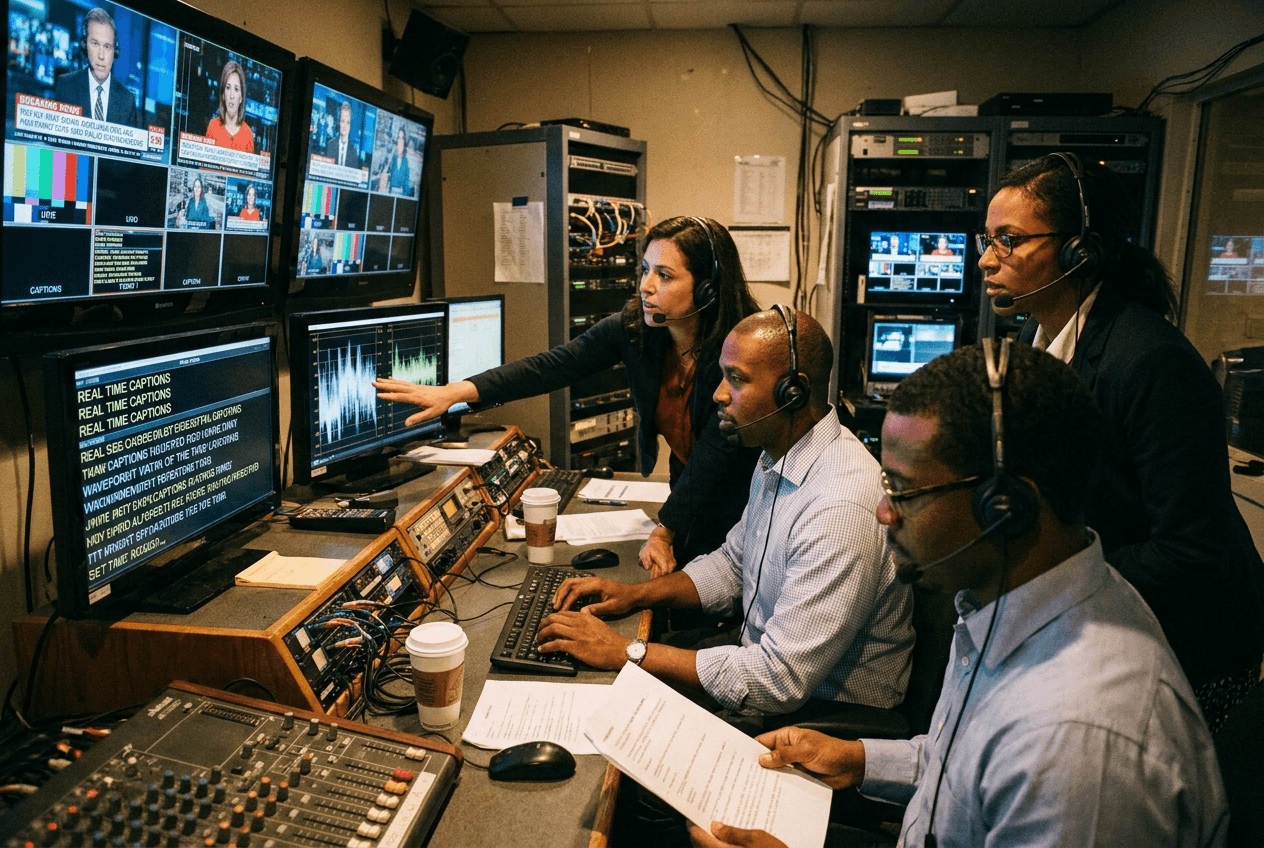
Operational speech workflows require different approaches
Discuss transcription, monitoring, accessibility, or conversational analysis requirements with the VoiceInteraction team.