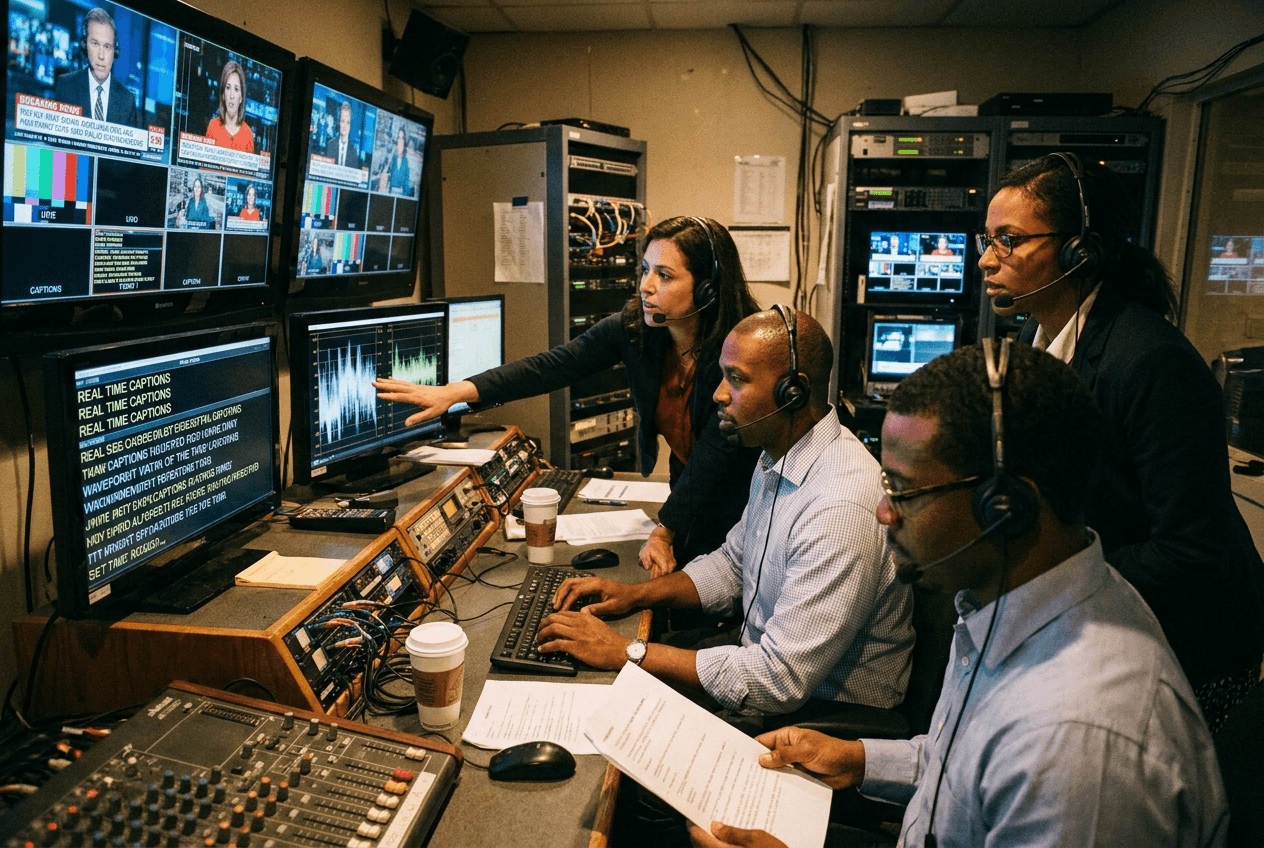

Understanding how organizations transform live speech into actionable information
Every day, organizations generate vast amounts of spoken information. News broadcasts, emergency communications, customer interactions, public meetings, intelligence operations, and media productions all rely on audio as a primary source of information.
Historically, much of this information has remained difficult to access in real time. Audio must first be listened to, reviewed, interpreted, and documented before it can support operational decisions. This creates delays between an event occurring and an organization being able to act on the information it contains.
Advances in speech recognition, language technologies, and AI are changing that model. Organizations are increasingly moving toward real-time audio intelligence systems capable of transforming live speech into structured, searchable, and actionable information as events unfold.
Beyond transcription
Real-time audio intelligence is often associated with automatic transcription, but transcription is only one component of a broader process.
The objective is not simply to convert speech into text. The objective is to transform spoken information into operational awareness.
A modern audio intelligence workflow may include:
Speech recognition
Speaker identification
Language detection
Topic classification
Keyword monitoring
Metadata extraction
Sentiment and interaction analysis
Content categorization
Automated alert generation
Together, these technologies enable organizations to move from passive recording to active information processing.
Why real time matters
In many environments, information loses value as time passes.
Broadcasters need to caption live content while it is on air. Public institutions may need to monitor ongoing events. Contact centers require visibility into customer interactions as they occur. Security and intelligence teams often operate in situations where delayed analysis limits operational effectiveness.
The challenge is that these environments rarely provide ideal conditions for AI systems.
Real-world deployments must operate with:
Limited latency
Variable audio quality
Multiple speakers
Domain-specific terminology
High availability requirements
Security and privacy constraints
Research in real-time audio intelligence focuses not only on improving recognition accuracy but also on ensuring that systems remain reliable under operational conditions.
The role of operational constraints
Many speech technology demonstrations are evaluated in controlled environments using curated datasets and stable infrastructure.
Operational environments are different.
A live television broadcast cannot pause while a model recalibrates. A critical communication workflow cannot tolerate extended processing delays. Investigative systems often require secure processing within controlled infrastructure.
These constraints influence how speech technologies are designed, deployed, and validated.
For this reason, real-time audio intelligence research increasingly focuses on questions such as:
How can latency be reduced without sacrificing accuracy?
How can speech systems adapt to specialized vocabularies?
How can AI models remain reliable in noisy environments?
How should speech technologies be evaluated in operational settings?
How can organizations maintain control over sensitive information?
Addressing these questions requires a combination of research, engineering, and practical deployment experience.
From audio streams to operational workflows
As organizations become more dependent on spoken information, audio intelligence is evolving from a standalone capability into a foundational layer of operational systems.
Speech data increasingly supports:
Accessibility
Real-time captioning and multilingual content delivery.
Content Operations
Automated clipping, metadata generation, content discovery, and publishing workflows.
Investigation and Analysis
Bullet Searchable records, evidence review, and information discovery.3
Knowledge Management
Making spoken information accessible across large repositories of audio and video content.
Human-AI Collaboration
Supporting operators with real-time information extraction and decision support tools.
Looking ahead
The next generation of speech technologies will extend beyond transcription toward systems capable of understanding, organizing, and acting upon spoken information in real time.
Research in real-time audio intelligence continues to explore how speech recognition, language technologies, AI models, and operational workflows can be combined to support faster decisions, greater situational awareness, and more efficient use of information.
As audio becomes an increasingly important source of operational knowledge, the ability to transform speech into actionable intelligence will become a core capability across media, public sector, enterprise, and security environments.
← Back to all articles



Operational speech workflows require different approaches
Discuss transcription, monitoring, accessibility, or conversational analysis requirements with the VoiceInteraction team.